The 2nd Boer War took place between October 1899 and May of 1902. The conflict was colonial in nature with the Afrikaners (of German / Dutch ancestry who were pushed out of British South Africa and founded their own states of The Orange Free State and the Transvaal) coming into conflict with the British Empire. Britain had largely ignored the Afrikaner states until gold was discovered. Britain feared that the Afrikaners would sell these resources to Germany – a key rival of Britain. Germany, lacking an empire to rival the British, had engaged in aggressive diplomacy globally and sought to challenge its industrial rival Britain for dominance.
Britain believed that since the colonists were once under British dominion that the British empire should be the only source of trade for the gold. To the Afrikaners, the natural resources were key to their individualism and continued sovereignty and as a result they sought the best price for their resources. Over the course of the gold rush thousands of citizens of the British empire flocked to the Afrikaner states in pursuit of wealth. These newcomers were not allowed to vote and were not provided full citizenship rights by the republics. Britain would use this issue to rationalize its intrusion on these state’s sovereignty. Coaxed into conflict the Afrikaner militias advanced into British territory when negotiations failed.
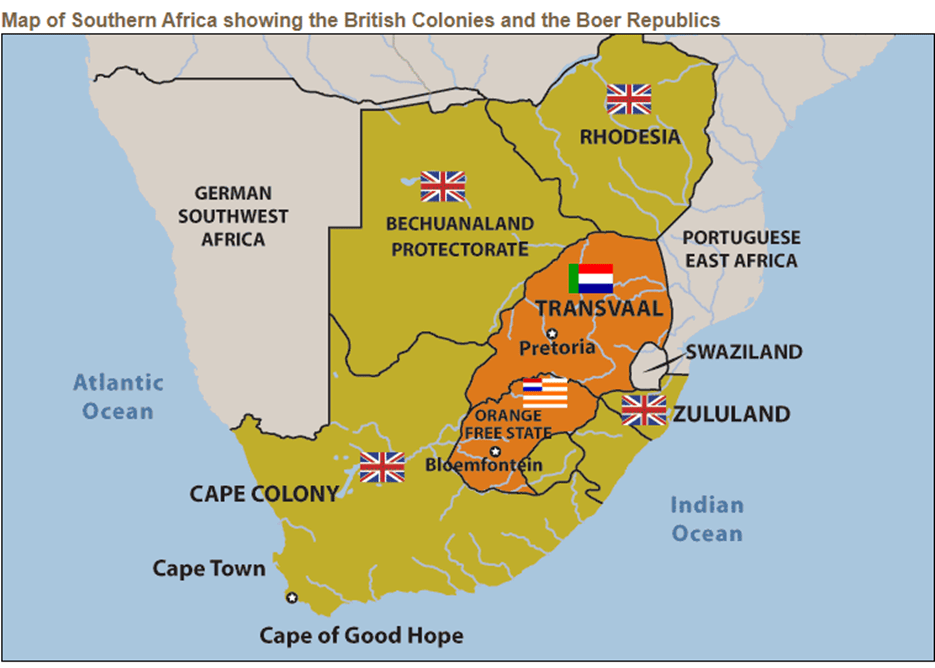
The Boers (Afrikaners) used small groups called Commandos who rode horses and struck deep into British territory with speed while avoiding pitch battles that would benefit the British. British infantry could be engaged and disengaged at the choosing of the Boers using these tactics. Boer troops were also armed with modern Mauser styled weapons bought from the Germans. These tactics overwhelmed the British forces leading to a huge loss of life.
Under Lord Kitchener, British forces struck back sending a 180 000-man force into Boer territory in 1900. Key to this force would be auxiliary cavalry units and dragoons from Canada and Australia. As British forces became more mobile, Boer attacks were blunted and outcome of the war changed.
The Boer War plays an important role in Canada’s military and political history. The late 19th Century and early 20th Century represented a high point for the British Empire. Many Canadians saw themselves as members of the empire and felt an immense sense of national and ethnic pride in their position on the world stage. Many English-speaking Canadians identified more with their ethnicity than with their newly acquired political identity as Canadians. Most English-speaking Canadians supported the British Empire and saw its greatness as a reflection of their own identity. Because of this connection to empire, calls went out from a large segment of the population for Canada to support the British directly in the Boer War. This sentiment clashed with the identity of French Canadians clustered in Quebec. To the French, support for a foreign war that would lead to the conquering and subjection of a formerly independent people to British control, did not represent their values or the values they wanted Canada to retain.
Prime Minister Wilfred Laurier had a difficult choice to make with large segments of the Canadian population divided over the conflict. If Canada joined the war, his base of support in French Canada would erode and tensions in Canada could lead to unknown domestic consequences. If he did not support the war, most of Canada’s population with British ancestry would mobilize against him politically. He also faced pressure from the British government who felt that if Canada would not commit to defending British values and empire then previous British guarantees for the protection of Canada could also be in jeopardy. The British were especially interested in the involvement of the North West Mounted Police and western “cowboys” as mounted fighters.
Laurier compromised and decided to allow Canadians to volunteer for the British army on mass without penalty. Thousands of Canadians would volunteer for overseas service and they would play a key role in Lord Kitchener’s counterattack. In total over 7000 Canadians including 12 nurses served overseas participating in key battles at Paardenber and Leliefontin. 267 Canadians were killed in action. Units that served in the Boer War included: Lord Strathcona’s Horse, The Royal Canadian Dragoons, 2nd Battalion Royal Canadian Regiment, 2nd, 3rd, 4th, 5th and 6th Regiments of the Canadian Mounted Rifles, Royal Canadian Field Artillery, 10th Canadian Field Hospital, The Canadian Scouts and the 3rd Special Service Battalion who replaced the British garrison at Halifax.
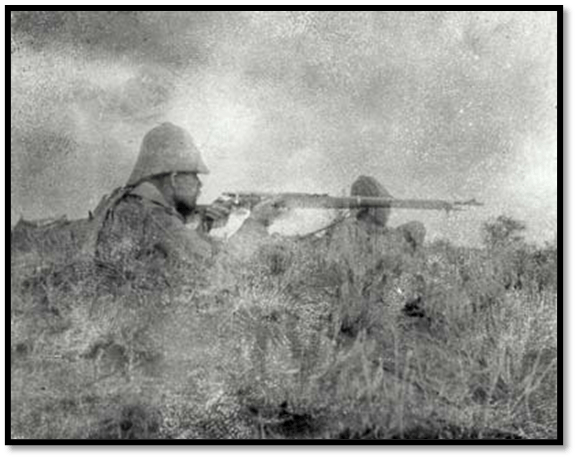
(Picture: Canadian infantrymen engaging the Boers, 18 Feb 1900)
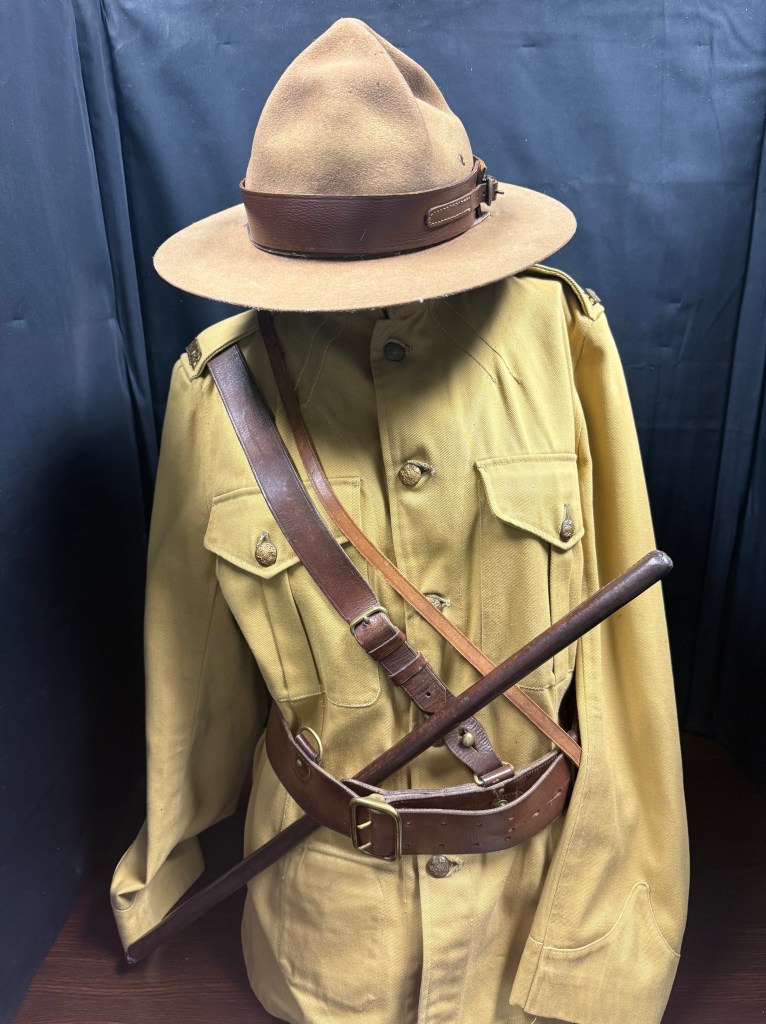
On display at the museum are two uniforms worn by Canadian volunteers during this conflict. Specifically the uniforms belonged to Sergeant Ira Milner – 2nd Canadian Mounted Rifles. Although British uniforms were made from khaki material, Canadian suppliers struggled to provide adequate uniforms for volunteers and many early uniforms were made of canvas or wool. These uniforms were eventually replaced with khaki from British stocks. The first Canadian troops to arrive wore the 1898 Cork pattern pith helmet before these were replaced with caps. The 1898 Helmet was white, and troops would use coffee to stain them to a more camouflaged beige. Canadian troops were armed with the new Lee-Enfield Mk 1 .303 rifle – improved versions of which would serve Canadian troops through both world wars.



Kevin Rodgers, Curator
Sourced / Extended Reading:
Canadian War Museum, Jerome Foldes-Busque. “Canada & the South African War, 1899-1902.” WarMuseum.ca – Canada and the South African War (Boer War) – 1899-1902. Accessed October 8, 2024. https://www.warmuseum.ca/cwm/exhibitions/boer/boerwarhistory_e.html.
 Welcome to Wood Buffalo Military Museum Centre